
It was a banner year for our MIE Capstone Design projects and our fourth-year Mechanical and Industrial Engineering students. The annual MIE Capstone Design Showcase celebrated the year-long projects that teams work on to create innovative solutions for our new and existing clients. Faculty, family, friends, and clients joined the students at Hart House to view the prototypes and posters and learn more about the projects. The Showcase wrapped with an awards presentation to our top teams. For 2025-2026 they include:

1st Place Capstone Design Project Award (Mechanical)
Project Title: Micro-Sanitation Unit Mixing System Improvements/ Project Supervisor: Professor Ali Dolatabadi
Disease and limited economic development are two of the direct results of the almost 500 million tons of untreated human waste discharged into the environment yearly. Client Sankoya Technologies wanted to develop and introduce a new approach to sanitation infrastructure. Team members Zhaoyang Rui, Jasmine Gong, Joe Huang and Linxi Chen focused on making improvements to the solid waste combustion system, specifically to the mixing drive system which can be damaged due to its placement on the on-site micro-treatment system. The project involved moving the drive outside of any interference with waste and performing the consequent required design work to produce a solution that needs less maintenance and replacement, which better contributes to Sankoya’s goals.

1st Place Capstone Design Project Award (Industrial) and Peri Family Industrial Engineering Design Award
Project Title: Junction: A Fairness-Aware Group Dining Decision Support System / Project Supervisor: Professor Scott Sanner
Group dining decisions are often slow, hard to coordinate, and dominated by the most vocal person, especially in on-the-go settings. Team member Fahd Fares, Kamal Al-Alwan, Krasimir Toskov and Leen Ghazal were tasked with developing a design system solution for their client iNAGO Inc. The goal was to find a system that would recommend restaurants reflective of group preferences, support fairer group decision-making, and reduce the effort needed to reach a shared choice. The result was Junction: a web-based system that captures each user’s preferences in natural language, and produces ranked restaurant recommendations that balance the group’s needs fairly. Users join a session through a shared code, chat their preferences naturally, and receive ranked results with personalized explanations, real-time voting, and a hands-free car mode for on-the-go use.
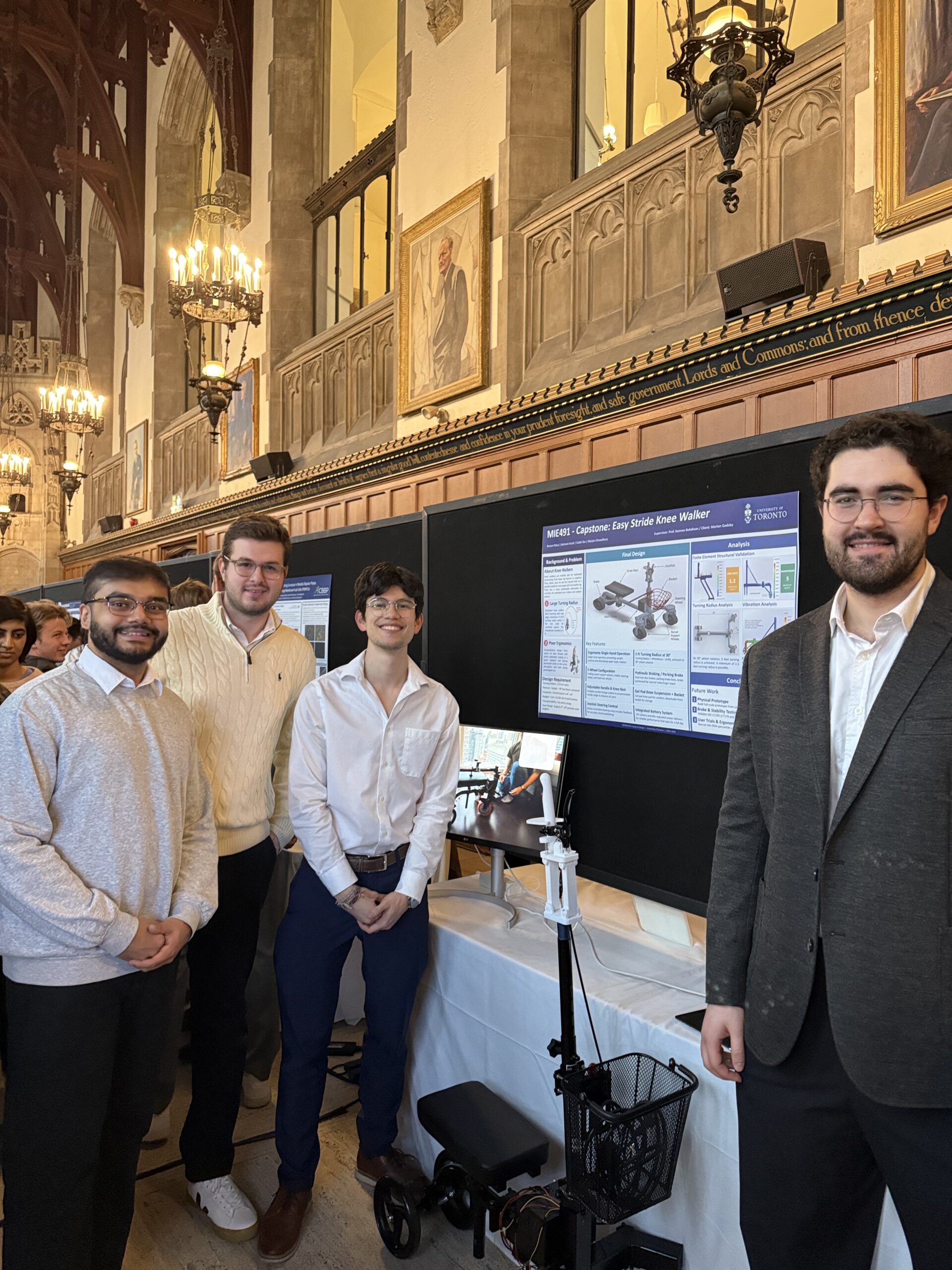
2nd Place Capstone Design Project Award (Mechanical)
Project Title: EasyStride Walker / Project Supervisor: Professor Kamran Behdinan
This project presented the design and development of a compact knee walker aimed at improving maneuverability and user ergonomics. Team members Marjan Chowdhury, Kerem Peksu, Caleb Tan and Mehmet Arcak created a five-wheel design to achieve a reduced turning radius, while enabling single-handed operation to enhance usability. Prototyping and testing demonstrated improved stability and reduced user strain compared to conventional designs. A foldable and lightweight chassis was incorporated to improve portability. The final prototype achieved a turning radius under five feet and met targeted braking performance, highlighting the potential for practical use in mobility assistance.

2nd Place Capstone Design Project Award (Industrial)
Project Title: Improving Staff Scheduling at Michael Garron Hospital Using Automation and Optimization / Project Supervisor: Professor Vahid Sarhangian
The Capstone team of Joshua Lee, Aaron Burkett, Kelvin Lo and Beliz Zorbozan developed a scheduling tool for their client, Michael Garron Hospital. The hospital previously used a largely manual process for assigning part-time staff to fill open shifts for their Environmental Services team. Included in the manual process was managing shift distribution fairness according to collective bargaining agreement rules, and seniority-based hospital preferences while ensuring full coverage in critical areas. The automated Excel-based tool used a mixed-greedy approach to allocate these shifts and reduce approximately eight hours of weekly manual work to around 10 minutes.
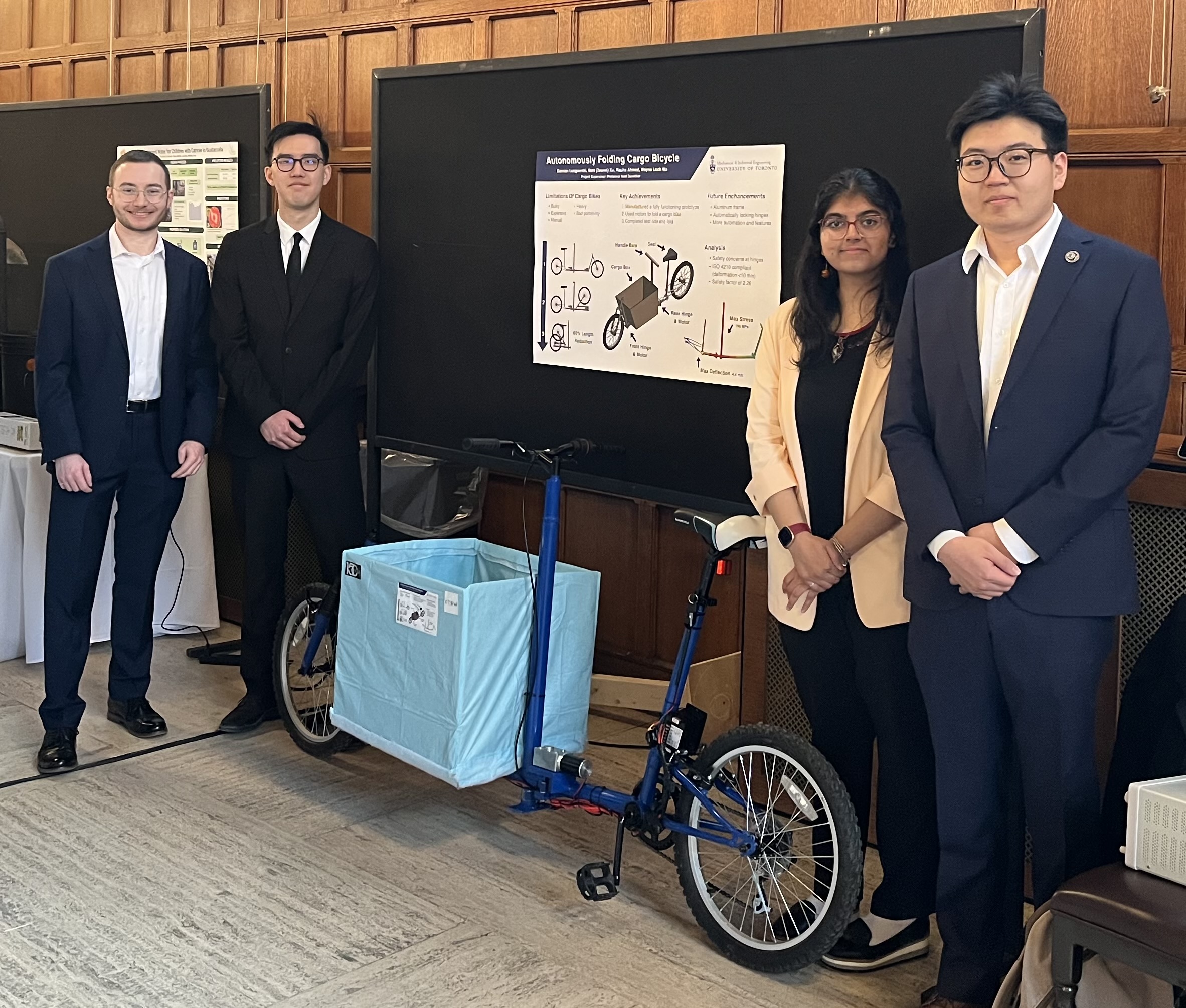
3rd Place Capstone Design Project Award (Mechanical)
Project Title: The Autonomously Folding Cargo Bicycle / Project Supervisor: Professor Axel Guenther
Conventional cargo bicycles are spatially inefficient, making it difficult to store at home or on public transit. To solve this problem for their client, Wayne Ma, Damian Lungowski, Rauha Ahmed and Matt Xu created an electro-mechanical hinge system to be integrated into a bicycle frame. The hinge design folded the bicycle into a compact shape with minimal user exertion. The team designed and manufactured a prototype that achieved a 60% reduction in length when folded, significantly improving portability without compromising utility. This design demonstrated a viable path for increasing the adoption of micro-mobility in dense urban environments.

3rd Place Capstone Design Project Award (Industrial)
Project Title: Improving User Experience in Hardware Assembly Documentation and Online Troubleshooting / Project Supervisor: Professor Janet Lam
Ploopy is a small Canadian startup that experienced a high volume of repetitive customer support emails. Ploopy engaged with students Izhaan Junaid, Sophia McGregor, Danny Wang and Shiqiao Bi to create a real-world solution to their overflowing inbox. To address this, the team created a three-pronged design solution: 1) a redesigned Help Center layout to encourage users to independently troubleshoot 2) a structured troubleshooting guide with email templates to improve communication consistency, and 3) refined assembly instructions for Ploopy’s flagship product by rewriting steps, retaking pictures, and including annotated visual aids. Usability tests showed that the revamped Help Center substantially improved task efficiency and the project concluded with Ploopy deploying these efficient resources.
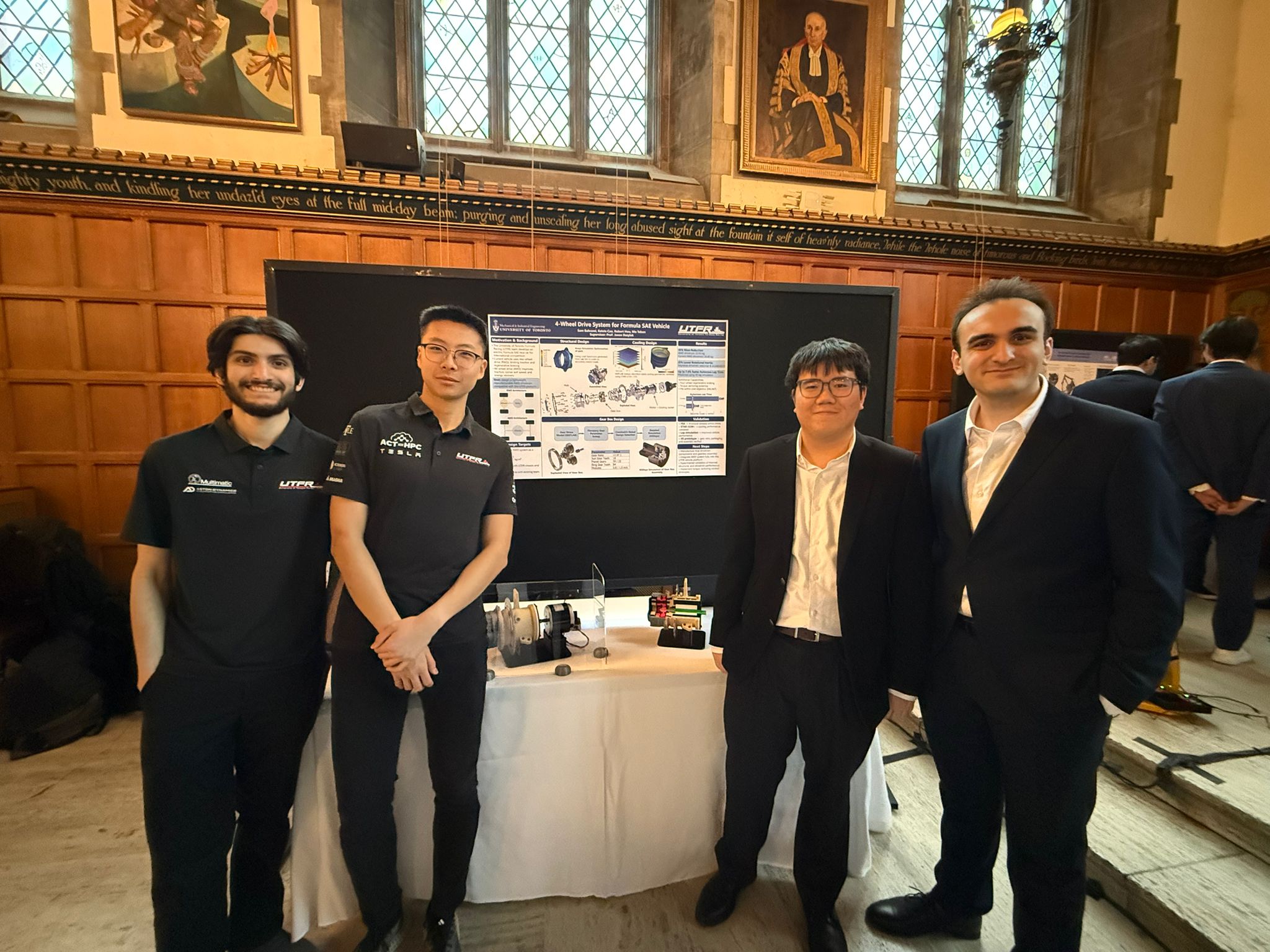
John H. Weber Scholarship in Mechanical Engineering
Project Title: 4-Wheel Drive System for Formula SAE Vehicle / Project Supervisor: Professor Jason Bazylak
The Capstone team of Mo Taban, Sam Bahrami, Kelvin Cao and Robert Hou presented a proof-of-concept all-wheel-drive (AWD) drivetrain for the University of Toronto Formula Racing (UTFR) vehicle. The objective was to determine whether AWD architecture could deliver measurable performance improvements while being mindful of constraints on mass, packaging, manufacturability, cost, and reliability. The final design was validated using analytical methods and high-fidelity simulation tools, including MATLAB, KISSsoft, finite element analysis, and STAR-CCM+ CFD simulations. Vehicle-level lap simulation predicted improved traction and dynamic performance relative to the current rear-wheel-drive baseline. A 3D printed prototype confirmed that the design can be practically implemented. The team demonstrated that AWD architecture is both technically feasible and beneficial for UTFR, establishing a clear pathway for transitioning from rear-wheel drive to all-wheel drive.
-Published by Kendra Hunter on May 26, 2026